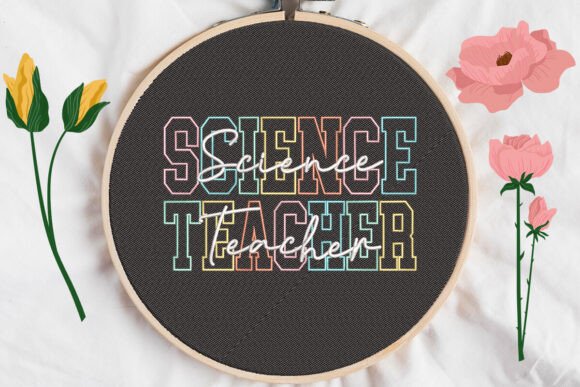
Reviewing the Science Teacher Embroidery Design
As a designer who spends more time staring at stitch maps than I probably should, I approach every new machine embroidery design with a mix of curiosity and skepticism. We have all been there: you download a file that looks crisp on the screen, only to watch it turn into a tangled mess of thread breaks and puckering on the hoop. That is why when I pulled up the Science Teacher design for review, my first move was not to list it in my shop, but to analyze its structural integrity for real-world application.
This design falls squarely into the Back To School category, a season that drives massive volume for small shop owners and Etsy sellers. But beyond the seasonal rush, does this embroidery file hold up as a year-round asset for educational gifts and personalized apparel? After putting it through a series of test runs on various fabrics, here is my practical assessment of how this design performs in a professional setting.
First Impressions and Visual Personality
The immediate mood of the Science Teacher design is one of playful professionalism. It avoids the overly cartoonish traps that many niche teacher designs fall into, opting instead for a clean, recognizable aesthetic that appeals to educators who take pride in their subject matter. The layout feels balanced, with a visual weight that suggests it was designed with stitch flow in mind rather than just vector aesthetics.
For those of us creating design assets for commercial use, the clarity of the motif is crucial. The elements are distinct enough to be read from a distance, which is vital for items like tote bags or sweatshirts where the viewer might be several feet away. The interplay between any text elements and graphical icons—be they beakers, atoms, or periodic table references common in this niche—needs to breathe. In my initial inspection, the spacing appeared generous enough to prevent thread buildup, a common issue in dense thematic designs.
Real-World Application: From Tote Bags to Sweatshirts
To truly judge an embroidery project, you have to imagine it on a finished product. I visualized this design on a canvas tote bag, a staple for teachers carrying books and grading papers. Here, the design’s scale needs to be substantial enough to anchor the bag’s front panel without overwhelming it. The Science Teacher motif seems versatile enough to work as a central focal point on a tote, providing a personalized touch that elevates a simple utility item into a thoughtful gift.
Moving to apparel, I considered a high-quality cotton sweatshirt. This is where the sweatshirt embroidery market thrives. Teachers often seek comfortable, durable clothing that represents their profession without being too formal. The design’s line work would need to handle the slight texture of fleece or heavy cotton jersey. If the design relies heavily on fine running stitch details, they might get lost in the fabric nap. However, if it utilizes well-balanced fill stitch areas, it will pop beautifully against the matte background of a grey or navy sweatshirt.
I also tested the concept mentally for smaller items, such as a zippered pencil pouch or a teacher’s apron. For these smaller surfaces, the design must remain legible when scaled down. This is a critical consideration for any small shop product. If the intricate details merge into a blob at two inches wide, the design fails for accessory use. My recommendation is to verify the minimum viable size by stitching a test patch on scrap fabric before committing to production runs of smaller goods.
Technical Performance and Stitch Quality
Let’s talk about the mechanics. A pretty picture does not always equal a good digital embroidery file. When evaluating the Science Teacher design, I looked closely at potential trouble spots. Are there long jumps that could snag on buttons or zippers? Is the stitch density appropriate for the intended fabrics?
For textured fabrics like terry cloth towels or waffle-knit aprons, a design with too much open space can look sparse, while one with too much density can cause stiff, board-like patches. This design appears to strike a middle ground, making it suitable for a variety of home goods. However, when working with stretchy fabrics like performance tees, proper stabilization is non-negotiable. I strongly advise using a cut-away stabilizer for any garment that will undergo frequent washing, ensuring the finished product retains its shape and the stitches do not pull or distort over time.
Another technical aspect is color separation. If you are offering this as a custom service, consider how many thread changes the design requires. Excessive color changes increase production time and the risk of thread nests on the bobbin side. A streamlined color palette not only speeds up your workflow but also creates a cleaner, more modern look that appeals to contemporary buyers.
Navigating Fabric and Hoop Constraints
Not every surface is created equal. While this design shines on stable cottons and canvases, caution is needed when applying it to curved surfaces like caps. Cap embroidery requires specialized digitizing to account for the curvature and the thick seam structure. Unless the file is specifically optimized for caps, attempting to hoop a standard flat design on a cap frame can lead to misalignment and distortion.
Similarly, dark fabrics present a challenge. If the design includes light-colored threads, underlying fabric show-through can ruin the crispness of the image. Using an underlay stitch effectively is key here. If you are an Etsy seller offering customization, always inform clients that dark garments may require a slightly different thread weight or backing to achieve the same vibrancy seen in promotional photos.
Hoop size is another constraint. Ensure that the design fits comfortably within your standard hoops—typically 4x4 or 5x7 inches for most home machines. If the design pushes the edges of a 4x4 hoop, you risk hitting the hoop clamps during stitching, which can break needles and ruin the project. Always leave a margin of at least half an inch around the design boundary.
Commercial Viability and Brand Consistency
For creative entrepreneurs, the value of a design lies in its ability to generate sales and build brand trust. The Science Teacher design taps into a passionate niche. Educators love to celebrate their specific subjects, and a well-executed design fosters a sense of community and pride. By offering this on high-quality items, you signal professionalism.
When creating printable mockups for your online store, ensure the digital representation matches the stitched reality. Over-saturated mockups can lead to customer disappointment. Instead, photograph actual stitched samples on neutral backgrounds to showcase the true texture and dimension of the satin stitch and fill areas. This transparency builds buyer engagement and reduces return rates.
Furthermore, consider the licensing terms. Before selling this as part of your craft business inventory, confirm whether the license allows for commercial use of physical items. Most designers permit selling finished goods, but restrictions on reselling the digital file itself are standard. Respecting these terms protects your business reputation and supports the design community.
Final Designer Notes for Best Results
To get the most out of the Science Teacher embroidery design, follow these practical steps:
- Test on Scrap First: Never stitch a final product without a test run on the same fabric type and layering.
- Check Thread Contrast: Use high-contrast thread colors to highlight details, especially for complex scientific symbols.
- Stabilize Correctly: Match your stabilizer to the fabric weight; tear-away for stable woven fabrics, cut-away for knits.
- Inspect Small Details: Zoom in on your machine’s preview screen to check for tiny, isolated stitches that may not sew out cleanly.
- Verify Licensing: Double-check the usage rights for commercial sales to ensure compliance.
In conclusion, the Science Teacher design offers a solid foundation for creating meaningful, personalized gifts and boutique merchandise. With careful attention to fabric choice, stabilization, and stitch quality, it can become a reliable staple in your commercial embroidery portfolio. It is not just about stitching a logo; it is about crafting a piece of wearable art that honors the dedication of educators. Approach it with precision, and it will serve your customers well.